TOURIST GUIDE
Paradise Islands

TOURIST GUIDE
Paradise Islands

All information about Les Arbress de l'île de Saint Barthélemy

Almond tree

Terminalia cattapa L.
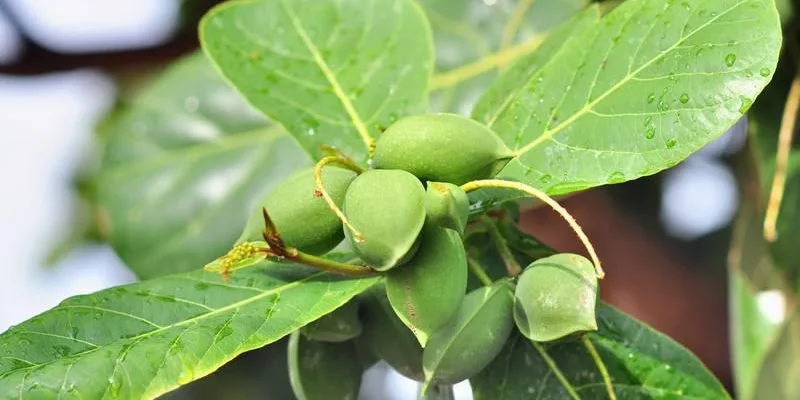
Common plant, found both in the wild and in gardens. Some almond trees produce red fruit, others white. All are edible. 
 
For many years, almonds have been recognized as a true source of tonicity. It is good for nerve and muscle tissue, skin and fertility.

Glue tree

Cordia_dentata,_known_as_White_Manjak_-_Flickr_-_Dick_Culbert
The peeled fruit was used as paper glue, to fix stamps or seal envelopes.
It is still present in the wild.

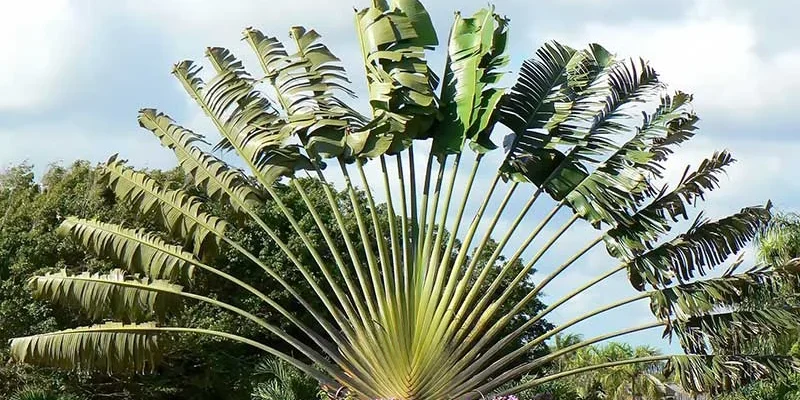
Traveller's Tree or Ravenala

traveler_tree

This tropical plant resembles a palm tree, with long, fan-shaped leaves. When fully grown, it reaches a height of almost 20m. It produces beautiful white flowers and intense blue fruits that attract birds. A real survival kit, it provides water, building materials and food (heart). 

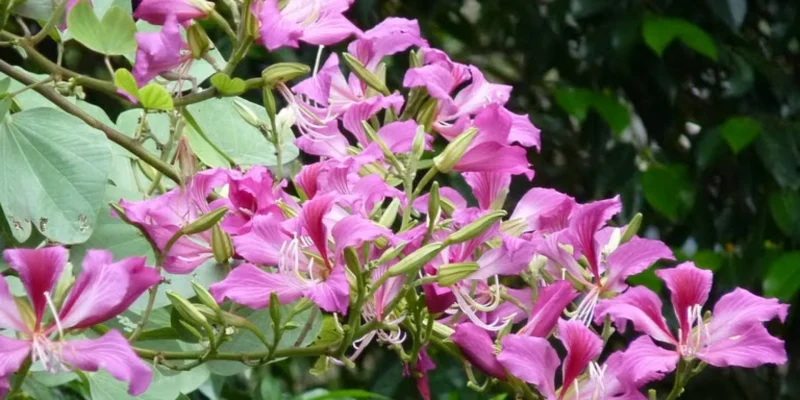
Orchid tree

BahuniaBlakeana2

A small tree averaging 2 to 3 meters in height. Short trunk with smooth bark. Branches are spreading. Its single leaves are large and heart-shaped. Its numerous pink to purple flowers give it an elegant appearance. The fruit is an elongated pod containing small, flattened black seeds.

Balisier

91rZ13meSOL._AC_UF1000,1000_QL80_
As its name suggests, the Caribbean balisier is native to tropical islands (Martinique, Guadeloupe, Saint-Martin...) as well as to Amazonia. Its height can easily reach 4 meters, depending on variety and exposure. In the West Indies, there are numerous species and varieties. The very large leaves are shaped differently depending on the species. They grow in humid areas, on rich soils and in more or less shady locations. 
The Caribbean balisier is a delight for tourists visiting remote islands. In its green setting, it's the perfect expression of the exuberance of tropical flowers. The leaves, similar in every way to those of the banana tree, offer a magnificent gradation of greens (soft to emerald). At its center, as if from nowhere, the flower is instantly recognizable. Like superimposed parrot beaks, the inflorescence is flattened and made up of multiple bracts. Each of these bracts, rough to the touch, holds a number of flowers inside, rather like a nesting doll.
The fruits are as stunning as the flowers. Intense blue, they are a delight for birds.  
The balisier is appreciated as a houseplant and for its bouquets, as its flowers last a long time, around 4 weeks. 

Boi Luil

Boi Luil was once used as a household cleaner for dishes and wooden floors. The ancients would first use bursa skins to clean the floor, then rub it with a bundle of Boi Luil leaves, the scent of which would pleasantly perfume the house for at least a week. Boi Luil is found both in gardens and in the wild.

Bougainvillea

bougainvillea-gold

Originally from South America, the Bougainvillea, discovered in Brazil by the botanist P. Commerson, takes its name from the French explorer Louis Antoine de Bougainville, who led the expedition. A climbing shrub with numerous thorns, it offers a colorful spectacle thanks to the tips of the branches surrounding the small white flowers. 

Calabash

calabash-4763639_1280
Originally, the Caribbean Indians made "Couis", earthenware dishes. Eventually, clay was replaced by calabashes, which were also used for a variety of everyday containers.
The calabash tree has almost disappeared in the wild, as it has in gardens.

Canéfice

Chinese cinnamon or cassia is also known as false cinnamon or "canéfice". Less appreciated than Ceylon cinnamon since Antiquity, and less expensive, it is the bark of the cassia cinnamon tree, a member of the Lauraceae family like the Ceylon cinnamon tree. Camphor belongs to the same family. 
Native to the mountainous regions of Annam (Vietnam), this tree is around 3 m tall, with large evergreen leaves and yellow flowers. They appear in late spring in long, hanging clusters, and turn into long, thick, cylindrical pods, ranging in color from brown to black. It is necessary to bark the trunk to harvest what becomes this fragrant aromatic stick.
Canefruit is first mentioned in a treatise attributed to the emperor Sheng-Nung, who reigned in 2700 B.C. It is mentioned as a medicinal herb in the Code of Hammurabi, king of Babylon from 1728 to 1686 B.C., and on the 16th-century B.C. Egyptian Ebers papyrus. 
The bark is thinner, darker and rougher than that of Ceylon cinnamon, with a less delicate, more pungent and acrid flavor. The bark is rough and grayish-brown on the outside, but the inner layer is reddish-brown. It produces shorter, more compact sticks that don't need scraping. Very hard, they are generally ground. 
It has many virtues. In the past, it was used as a tonic and to treat diarrhea and intestinal disorders. The essential oil has a strong peppery odor. It is digestive, antispasmodic and an intestinal antiseptic. It relieves muscular cramps. It also has a respiratory, cardiac and... sexual tonic action. It is an external antiseptic. 
Used internally, it is prescribed for fatigue, gastritis, indigestion, digestive spasms and impotence. Externally, it is used as a rub to treat abscesses, boils and insect bites, or in stimulating, toning baths to promote circulation. Inhaled essential oil combats head colds and flu. 
In the Middle Ages, cassia, like cinnamon, was used in flavored wines, elixirs, love potions, charms and irresistible perfumes.
The plant is appreciated for its decorative value. It is often planted in gardens and along streets. In India, the tree's bark is used as a tanning agent. The reddish wood is hard, heavy, strong and durable, and is suitable for all types of joinery. 

Cotton

seeds-of-cotton-gossypium-herbaceum-cotton-herbac-1

Cotton has been the most widely used plant fiber for millennia, and is used to manufacture absorbent cotton, yarn and fabric. Soft, supple and comfortable, cotton knitwear is a real pleasure to wear. Its cultivation in Saint-Martin / Sint Maarten began in the 18th century and continued until 1848 (abolition of slavery). 

Flamboyant
flamboyant_0

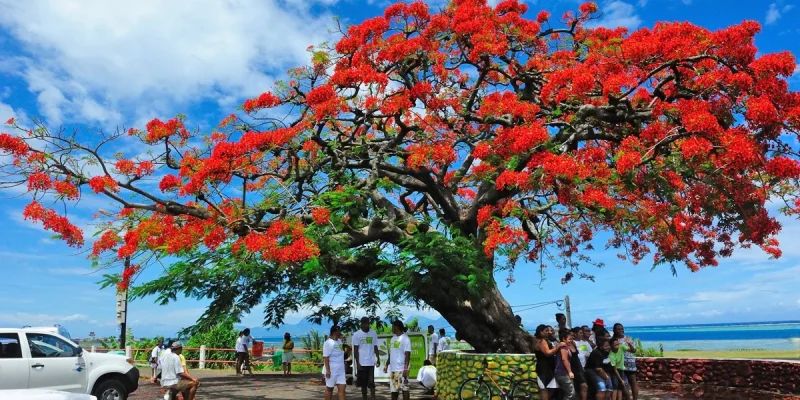
This tropical tree is common in the West Indies, where it can reach heights of up to 15 meters. Recognizable by its parasol shape, it produces magnificent red or yellow flowers that appear towards the end of the dry season. 

Frangipani

family-frangipani-big

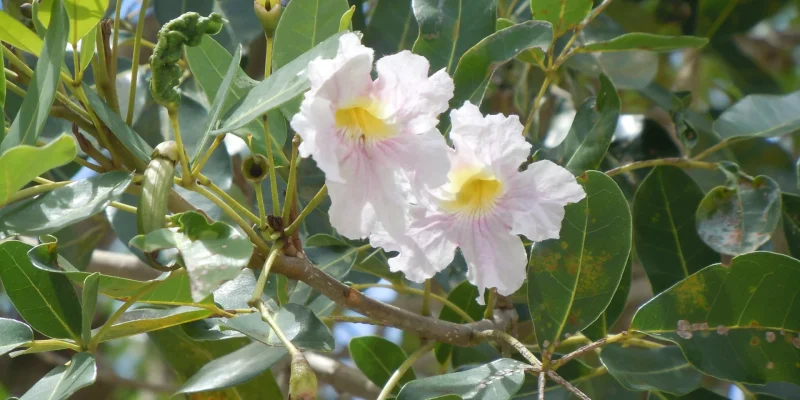
Native to Central America, the frangipani, otherwise known as Plumeria, has flowers ranging from white to pink, with a fragrance of rare intensity. Very popular in all tropical regions of the world, it is associated with numerous rites and celebrations. And while the sap is poisonous, the flower is used in pastries! 

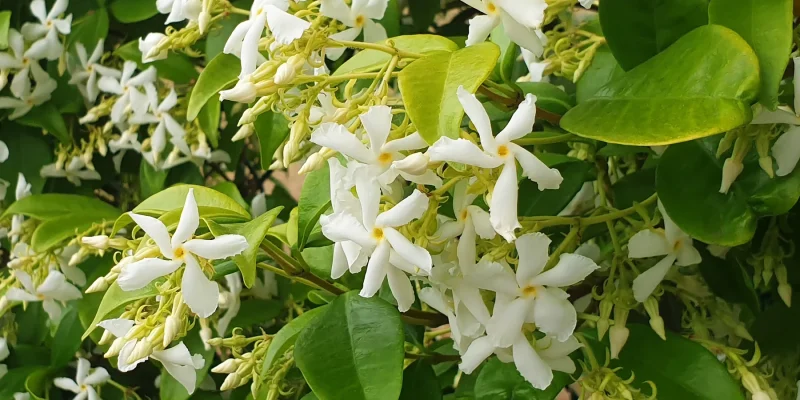
Jasmine

Jasmin_saint-martin

A small, voluble liana, jasmine has many small white flowers with an intense fragrance. A common sight in gardens, some say it originated in Madagascar, others in China. But whatever its origin, it's the perfect match for the St Barths landscape, diffusing a bewitching fragrance! 

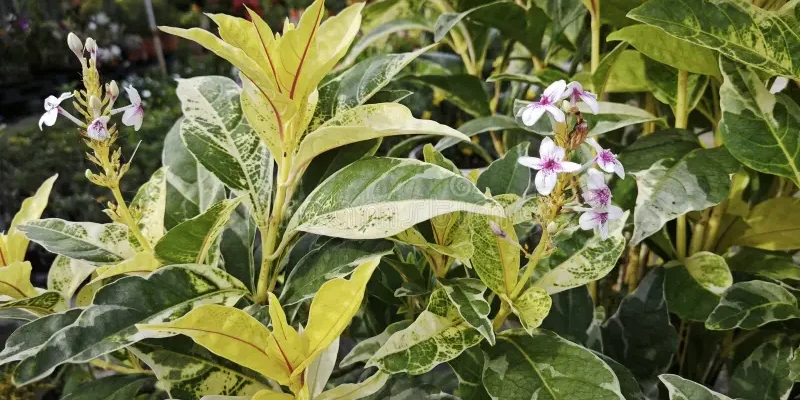
Creole thought

spots-pink-purple-pseuderanthemum-maculatum-petals-of-flowers-plant-image-of-370717119

Small ornamental shrub, generally less than 2 meters tall, rarely taller, native to Polynesia. Grown for its beautiful foliage and flowers. Young leaves are yellow and green. The flowers, in terminal clusters, are predominantly white with central purple spots.

Pear tree

Tabebuia_heterophylla-_Martinique
A fairly large deciduous tree, common throughout the island, originally from tropical America. Well-adapted to drought, it has difficulty with strong winds. The trunk is cylindrical, cracked or ribbed. Leaves are composed of 3 to 5 leaflets.
Tabebuia heterophylla 
 
A fairly large deciduous tree, common throughout the island, originally from tropical America. Well-adapted to drought, it has difficulty with strong winds. The trunk is cylindrical, cracked or ribbed. Leaves are composed of 3 to 5 leaflets.

Seaside plum

Scaevola plumieri

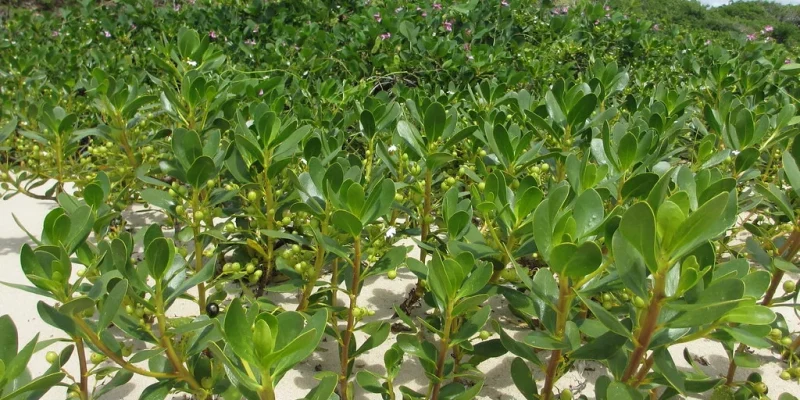
Shrub 0.70 to 1.20 m high. The stem is thick, but often lies on the sand and is rooted by layering. It rises at the ends. The fleshy leaves are thick and shiny. The flowers are small and white. The fruit is a juicy drupe, smooth and blackish when ripe, resembling an olive. Found at sea level and on sandy beaches.

Reseda
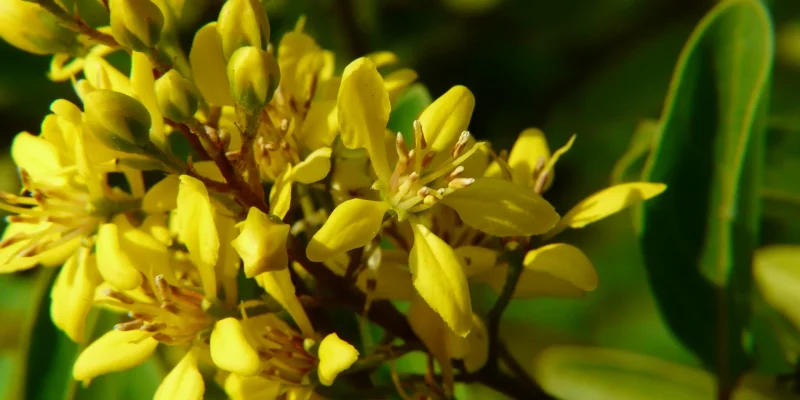
Galphimia_glauca

A very ornamental shrub with an average height of 1 to 2 meters, native to Mexico. It has an attractive, branched habit and is covered with glossy, light-green foliage. Its bright yellow flowers form magnificent terminal panicles. Fruits are small green capsules, 3 to 5 mm long, and the small brown seeds measure no more than 3 mm. Resistant to drought and grows in a variety of soils.

Moth

Annual, chlorophyll-free, leafless herbaceous plant. Its yellow or orange, thread-like, cylindrical stem is very long, branched and twisted on its support. It clings by suckers to other plants, even trees, which it sometimes ends up killing. Fortunately, it is an annual plant, which lessens its effects and justifies its presence in the landscape being more or less invasive from one year to the next. However, it does produce flowers that give rise to capsules about 2 mm in diameter, containing one or two small seeds that ensure its reproduction.